Varroa, year after year
Varroa destructor remains the main reason colonies die. What treatment schemes achieve — and what they do not.
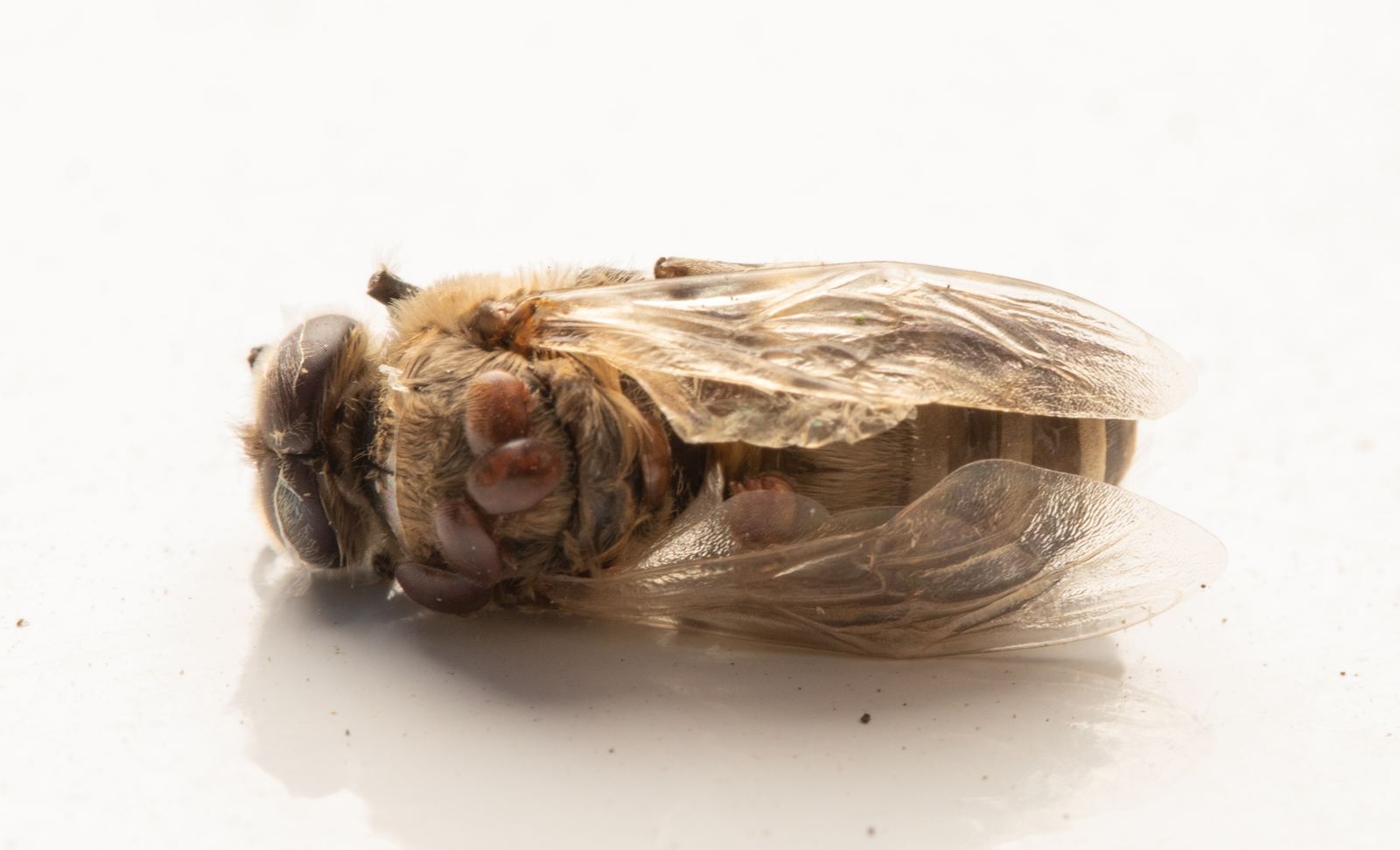
Varroa destructor is a parasite that reproduces in sealed brood. The adult mite is oval and flattened, and at roughly 1.1 by 1.6 millimetres it is plainly visible — a giant relative to its host.
The damage comes less from feeding than from the viruses the mite transmits. Deformed wing virus leaves bees unable to fly; in autumn it hits precisely the winter bees that must carry the colony through to March.
So timing matters more than the product. Treating once damage is visible is treating too late: the winter bees are already compromised.
Mite load across the season
Mites per ten grams of bees, guide values for an untreated colony. Around five mites is generally taken as the damage threshold.You are not treating the mites. You are treating the winter bees.
A workable scheme combines a summer treatment after the last harvest, biotechnical measures such as drone brood removal, and a winter treatment while the colony is broodless. Organic acids depend on temperature and humidity — treatment windows belong in the calendar, not in the gut.
Monitoring stays compulsory: floor debris counts or the icing-sugar method, fortnightly through the second half of the season. Numbers beat hunches.